7
 Athletic Club
Berenguer
Athletic Club
Forward
 Spain
Spain



 mar
mar

 ray
ray

 ath
ath
 gir
gir
Find out where and when you can watch the great match of the day Betis VS Sevilla, a decisive duel. Enjoy the Andalusian derby on LALIGA!

Find out where and when you can watch the great match of the day Betis VS Sevilla, a decisive duel. Enjoy the Andalusian derby on LALIGA!

Find out where and when you can watch the great match of the day Betis VS Sevilla, a decisive duel. Enjoy the Andalusian derby on LALIGA!
Find out where and when you can watch the great match of the day Betis VS Sevilla, a decisive duel. Enjoy the Andalusian derby on LALIGA!
Athletic Club, more commonly known as Athletic Bilbao, was founded in 1898 in the Basque city of Bilbao. The club emerged at the turn of the 20th century when football was spreading through Spain thanks to British workers and students. Athletic quickly became a powerhouse in the Basque Country and one of the pioneering clubs of Spanish football.
One of the club’s defining features is its unique philosophy of fielding only players who are born in, or have trained in, the greater Basque region. This tradition, often referred to as the cantera policy, has become a hallmark of Athletic’s identity and a symbol of cultural pride. Despite these limitations, the club has remained remarkably competitive at the highest level of Spanish football.
Athletic Club’s golden years came in the 1920s and 1930s, when the team secured several Copa del Rey titles and their first LaLiga championship in 1929–30. Legendary figures such as Telmo Zarra, one of the most prolific scorers in Spanish history, helped cement the club’s reputation as a dominant force. Over the decades, Athletic developed a fierce rivalry with Real Sociedad in the Basque derby, as well as with giants Real Madrid and FC Barcelona.
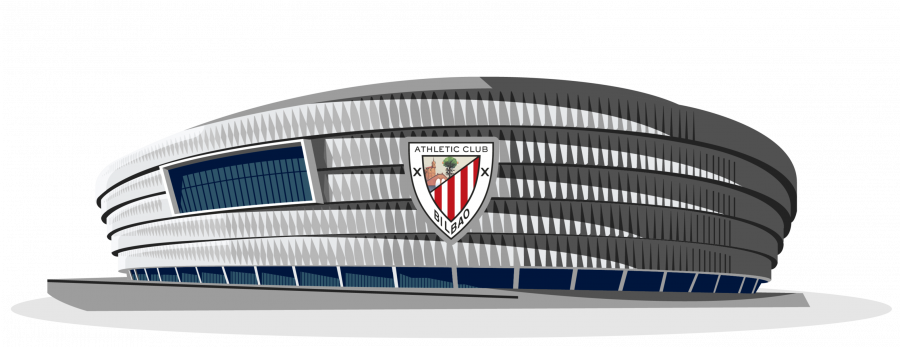
The team plays its home matches at the iconic San Mamés Stadium, inaugurated in 1913 and completely rebuilt in 2013 with a modern design. Known as “La Catedral” of football, it is considered one of the most atmospheric venues in Spain, where the passion of the Basque supporters creates an unforgettable matchday experience.
Throughout its history, Athletic Club has won more than 20 Copa del Rey trophies and 8 LaLiga titles, making it one of the most decorated clubs in Spain. Remarkably, it is one of just three clubs (alongside Real Madrid and Barcelona) never to have been relegated from LaLiga, a testament to its consistency and resilience.
In the modern era, Athletic continues to challenge at the top of Spanish football while staying true to its Basque-only policy. The club’s academy, Lezama, is regarded as one of the most productive youth systems in the country, producing players who embody the fighting spirit, loyalty, and technical quality that define Athletic’s philosophy. This balance of tradition and competitiveness ensures that Athletic Club remains not just a football team, but a cultural institution in Spain and across the world.